Local broadcasters keep you connected and informed. Learn about how we serve Americans every day, the economic impact we have on local communities, read stories of broadcasters' public service and more.
In 2025, local broadcasters came together to advance our shared mission of informing communities, strengthening local journalism, providing the best entertainment and keeping audiences safe. This Year in Review highlights the milestones we achieved together through advocacy, education and innovation leadership.
Join our team of broadcast advocates. When legislative issues arise that could impact your station and career, we'll reach out and give you simple steps to contact your legislators.
The NAB Leadership Foundation works with current and aspiring leaders in broadcasting to build a more diverse, innovative and vibrant future for the industry by investing in our greatest resource: our people.
The premier destination for innovation – an unrivaled marketplace of bleeding-edge products, services and ideas – NAB Show drives the future of our industry across the entire workflow of creation, distribution, management and monetization.
NAB's SmartBrief is a daily snapshot of broadcast industry news pulled from numerous leading media sources. SmartBrief contains summaries of the news that matters to you, written by expert editors to save you time and keep you informed and prepared.
My NAB is a platform designed to create a more personalized and enhanced experience for our members to interact with NAB, access members-only content and easily register for programs and awards.
The Broadcast Resource Hub, powered by the National Association of Broadcasters and the NAB Leadership Foundation is a comprehensive one-stop shop for resources, tools and information on the most relevant issues impacting local television and radio stations.
NAB Member Services provides members with tools and resources to support their professional needs and interests. It's our mission to deliver benefits that positively impact members' business operations and career progression, as well as strengthen the future of broadcasting.
Local Broadcast Stations Need Modern Ownership Rules to Compete and Serve their Communities
ISSUE SUMMARY
For decades, Washington has regulated broadcast stations as though Americans still receive their news and entertainment from a handful of stations on an analog dial. That world is gone, and yet, rigid broadcast ownership limits written for an earlier era continue to prevent local TV and radio stations from competing effectively with national and global digital platforms.
The Federal Communications Commission (FCC) has the opportunity to update these outdated regulations through its pending "Quadrennial Review."" Congress requires the FCC to review its broadcast ownership rules every four years and to repeal or modify those that are no longer necessary.
The current rules continue to treat local television and radio stations as though their principal competitors are other broadcast stations. In reality, broadcasters compete for audiences, advertising revenue and investment capital against audio and video streaming services, podcasts, satellite radio, cable and satellite TV, social media, connected television and enormous digital advertising platforms.
These outdated restrictions make it harder for local stations to invest in local news, emergency coverage, sports, talent, technology and community programming.
The FCC should act quickly to modernize its local ownership rules so broadcasters can compete, invest and continue providing the free, local service Americans rely on.
Dive deeper:
The local radio ownership rule limits both the total number of stations a broadcaster may own in a market and the number of AM or FM stations it may own. Depending on market size, a broadcaster may own only five to eight stations in total, even in markets with over 100 radio stations. At the same time, Spotify, Apple, SiriusXM and other competitors can offer hundreds of channels for listeners.
These restrictions were established in 1996, before smartphones, social media, podcasts, satellite radio, connected cars and today's streaming marketplace fundamentally changed how Americans consume audio.
Local television stations also remain subject to ownership restrictions rooted in an era when viewers had far fewer sources of news and entertainment, limiting broadcasters from owning more than two stations in any TV market, even the largest.
Digital platforms face no comparable local ownership limits. They can reach virtually every consumer, use their national and global scale to attract advertising and investment and enter local markets without seeking FCC permission.
The advertising market has changed just as dramatically. Digital platforms now receive over 70% of local advertising spending, while broadcast radio stations collectively received only 4.7% of local businesses' advertising dollars in 2025.
Radio stations' total advertising revenue, including digital and over-the-air ad revenue from local and national businesses, declined 30.1% from 2007 through 2025, even before adjusting for inflation. The pressure is especially severe in smaller markets, where many stations must pay for employees, equipment, programming and emergency operations with extremely limited advertising revenue.
The ability to grow can help local broadcasters share the costs of newsrooms, engineering, sales, technology and content production. It can also provide the resources needed to launch new formats, improve digital products, hire and retain talent and strengthen emergency and severe weather coverage.
Growth can also lead to more options for listeners. A broadcaster operating several local stations has an economic incentive to differentiate those stations, reach distinct audiences and offer formats that are not already available in the market.
Modernizing the rules would not eliminate oversight. The FCC would continue reviewing proposed station transactions under its public interest authority and antitrust authorities would be responsible for examining genuine competitive concerns.
The bottom line:
The FCC should modernize the local radio and television ownership rules through the pending quadrennial review.
The current rules protect an outdated government-imposed structure, not listeners, viewers or local communities.
Without action, declining advertising revenue will continue to place pressure on local news, emergency information, severe weather updates, sports, community programming and the free over-the-air services millions of Americans depend on.
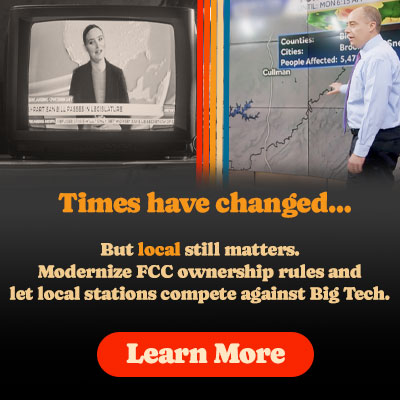
Times have changed. The rules should change with them.