For various reasons, televisions using cathode ray tube (CRT)
displays deflect the electron beam beyond the edges of the faceplate
front of the tube, resulting in areas at the edges of the transmitted
picture not being visible to the viewer. This characteristic,
known as overscan, requires critical action and titles to be constrained
to "safe areas" of the picture. The Society of Motion Picture
and Television Engineers (SMPTE) many years ago issued recommendations
for what these safe areas should be.
With the increased use of flat-panel LCD, plasma and other fixed
pixel matrix display televisions, the previously defined safe
areas are no longer appropriate and a new SMPTE standard, Specifications
for Safe Action and Safe Title Areas for Television was published
last year, together with a recommended practice Safe Areas for
Protection of Alternate Aspect Ratios. These were followed last
week by an Engineering Guideline Safe Areas for Television EG
2046-3, which explains the background and use of the new standards.
The following extracts from these documents are reproduced with
permission from SMPTE.
"It is the purpose of this Engineering Guideline to explain the
use of these documents and the relationships among them. A brief
history of TV safe areas and their evolution is also given.
From the early days of film and television, it has been recognized
that not all of the information contained in the original image
frame will necessarily be presented to the viewer. In television,
the principal limitation has been the use of overscan in the viewer's
receiver.
In 1957, the SMPTE Journal included a paper entitled Television
Receiver Picture Area Losses, in which the author, Charles Townsend,
describes research conducted at NBC's WRCA-TV in an effort to
determine the extent of the broadcast image that was actually
seen in viewers' homes. The paper is reproduced in Annex B. Note
that the safe area the author suggests is based on the assumption
that all elements within the safe area will be viewable on at
least 85% of receivers; no attempt is made to ensure viewability
on 100% of receivers.
The safe area pattern recommended is 80% of image height and
approximately 80% of image width, adjusted for the shape of the
mask, which reflects the circular shape of the CRTs then in use.
In 1961, SMPTE issued SMPTE RP 8, Safe Title Area for TV Transmission,
which specified this 80% width, 80% height rectangle with rounded
corners as the Safe Title Area. This was followed in 1963 by SMPTE
RP 13, Safe Action Area for TV Transmission, which specified a
90% width, 90% height rectangle with rounded corners as the Safe
Action Area. In 1968, the two RPs were combined into a revised
SMPTE RP 8.
In 2002, SMPTE issued SMPTE RP 218, which brought the specification
forward into the digital era by specifying safe areas in terms
of pixel and line counts rather than linear dimensions. The rounded
corners were also eliminated, as by that time consumer CRTs had
square corners. Although superseded, SMPTE RP 27.3 was kept on
the books for archival purposes.
All of these specifications and test patterns were based on the
characteristics of CRT-based displays, including rounded corners
(except in SMPTE RP 218) and safe-area margins large enough to
compensate for centering and geometry errors and the overscan
necessary to ensure that the CRT was completely filled with an
image even when the receiver's components had aged or the line
voltage sagged. These specifications - a safe action area 90%
of the width and 90% of the height of the full image area and
a safe title area 80% of the width and 80% of the height of the
full image area - persisted until near the end of the first decade
of the 21st century, despite significant improvements in CRT-based
receiver technology.
By 2007-2008 it had become obvious that the CRT was rapidly being
replaced by fixed-pixel-matrix (FPM) displays (plasma, LCD, DLP,
etc.) While these technologies have significant differences among
them, one characteristic they share is fixed image geometry. No
longer is the consumer display subject to changing picture size
due to conditions beyond the manufacturer's control. Moreover,
since the early 2000s many broadcasters had been utilizing the
space between the safe action area and the safe title area for
news crawls and other title information, knowing that on modern
CRT displays as well as FPM displays this information was virtually
certain to be legible. Another complicating factor was the wide
adoption of the 16:9 aspect ratio, making it necessary to create
images that would be acceptable on both 4:3 and 16:9 displays.
The result was the development of a new Standard, SMPTE ST 2046-1,
a new Recommended Practice, SMPTE RP 2046-2, and an amendment
to SMPTE RP 218.
Many broadcasters had hoped that it would be possible to utilize
the entire active picture area as the safe action area. However,
for a variety of reasons, FPM-based consumer receivers, even if
they are adjustable to show the entire image area, commonly default
to a small amount of overscan to conceal image processing and
compression edge artifacts. Moreover, although CRT-based receivers
are no longer sold, large numbers of them remain in use. Based
on research in the U.S., Europe and Japan, the specifications
in SMPTE ST 2046-1 and SMPTE RP 2046-2 were adopted.
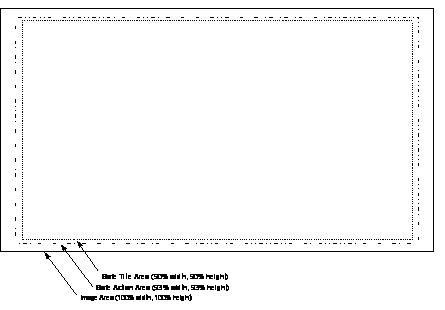
SMPTE ST 2046-1 defines the Safe Action Area as a rectangle that
is 93% of the width and 93% of the height of the Production Aperture
(or 720 x 480 in the case of 480-line formats) and concentric
with it. The Safe Title Area is defined as a rectangle that is
90% of the width and 90% of the height of the Production Aperture
(or 720 x 480 in the case of 480-line formats) and concentric
with it. Annex C of the Standard provides informative tables giving
the dimensions of these safe areas in terms of lines and pixels
for the most commonly used image formats. Annex D provides example
safe area graticules for both 4:3 and 16:9 aspect ratios, as well
as a graticule for 4:3 images using the legacy safe area percentages.
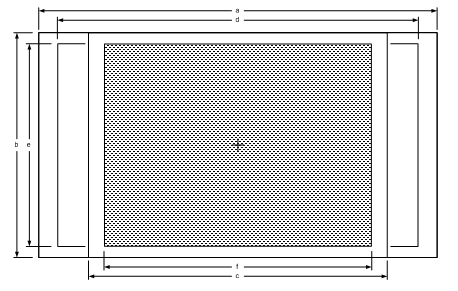
SMPTE RP 2046-2 defines safe areas that should be used when composing
16:9 images that will be presented on both 4:3 and 16:9 displays.
Two example graticules are defined, one for use when the 4:3 image
is to be created by cropping the sides of the 16:9 image and the
other for use when the full 16:9 image is to be presented in a
letterbox on the 4:3 display. These are described in the context
of the Active Format Description (AFD) specifications defined
in SMPTE ST 2016-1. SMPTE RP 2046-2 defines only 90%, 90% safe
areas.
Amendment 1 to SMPTE RP 218 deprecates its use except for formatting
of closed captions as defined in CEA-708. The exception exists
because all receivers deployed in countries that require the use
of CEA-708 display captions in a window whose extents are defined
by the old 80% width, 80% height safe title area defined in SMPTE
RP 218. CEA-708 normatively references SMPTE RP 218. For all other
applications, the amended RP directs users to SMPTE ST 2046-1
and SMPTE RP 2046-2."
Users are encouraged to refer to the full documents and not rely
on these extracts. Like all SMPTE standards, the new Safe Area
documents may be purchased from the SMPTE online store at: https://store.smpte.org/



