| |
Lip
Sync Revisited - Solutions Are in Sight
Previous editions
of TV TechCheck have reported on the problem of audio-video
synchronization, commonly known as "lip sync," where
noticeable errors are seen on television channels distributed
on terrestrial broadcasting, cable and satellite. There are various
reasons for this, including the introduction of complex digital
processing for audio and video that can introduce differential
delays for audio and video in production, post and distribution
systems.
Standards
organizations, including ITU, ATSC, SMPTE, EBU, IEC, AES, and
SCTE, have been studying the problem for many years, and there
are several standards and recommended practices for tolerances
that should be adopted for different parts of the broadcast chain.
The ITU-R
BT 1359 recommendation states that the threshold of detectability
of lip sync errors is about +45 ms to -125 ms (audio early to
audio late) and that the threshold of acceptability is about +90
ms to -185 ms, on the average. However, because of the uncertainty
of synchronization that may exist in the source material, the
ITU recommends that the timing difference in the path from the
output of the final program source selection element to the input
to the transmitter for emission should be kept within the values
+22.5 ms and -30 ms. These distribution tolerance figures are
comparable to the recommendations of the
ATSC IS/191 finding, which gives a range of +15 ms and -45
ms at the inputs to the DTV encoding devices, while the EBU recommendation
R37-2007
gives a range of +40 and -60 ms at the output intended to feed
broadcasting transmitters.
In the above-referenced
documents, the ITU states that if correction of errors is not
possible, then each downstream segment that is not under the control
of the broadcaster shall not introduce any timing error in excess
of +/-2 ms, while the ATSC says that designers should strive for
zero differential offset throughout the system, and the EBU recommends
that the accuracy of synchronization at each stage should lie
within the range of audio 5 ms early to 15 ms late. Some broadcasters,
and others, have questioned the particular tolerance recommendations
mentioned, but there is general agreement on the need to reduce
errors to a small value at each step in the broadcast chain.
It has been
known for some time that some consumer DTV receiver products can
introduce lip sync errors due to incorrect decoding and handling
of MPEG-2 signals. As reported in TV
TechCheck of August 3, 2009, the CEA has addressed the
problem (although only for new designs) with a recently published
Recommended Practice on A/V Synchronization Implementation
in Receivers. Apart from that publication, however, as yet,
there are few recommendations from the standards organizations
as to how the specified levels of synchronization should be achieved
through the broadcast chain.
Progress
with Solutions for Lip Sync Errors
A prerequisite for A-V sync correction is first to measure the
error. It is comparatively straightforward to assess or measure
lip sync errors in out-of-service paths using test signals, either
of the "beep-flash" type, such as the VALID8™
system from Snell/Pro-Bel, or test signals such as the Visualizer™
Test Pattern from Sarnoff (first mentioned in TV
TechCheck of
October 29, 2007). It is, however, much more difficult to
make such measurements in-service, with regular programming, but
this is where monitoring and correction is most important. One
current product that allows absolute measurements without affecting
the program is the LipTracker™
system from Pixel Instruments, but this only works when lip movements
are visible and is perhaps impractical to use for all programming.
The Tektronix AVDC-100 product was briefly available to detect
and correct changes over parts of the program chain using a watermark
signal but it was for SD video only and has been discontinued.
There have been other products that permit changes in A-V sync
to be detected and corrected, including those from Sigma Electronics
and K-WILL Corporation, these have been used successfully in facilities
where both input and output signals are available at one point.
At the NAB
Show 2009 earlier this year, Evertz
introduced the IntelliTrak™ system, for in-service measurement
and correction of changes in A-V synchronization that may occur
within a facility or over multiple links in a broadcast chain.
At IBC in September, Miranda introduced their Densite
HLP-1801 product with similar capabilities. Both these systems
are based on the concept of analyzing particular characteristics
of the audio and video incoming program signals and generating
an audio-video sync signature or fingerprint that can be
transmitted as metadata to a downstream point in the program chain.
At the downstream point, the audio and video signals are again
analyzed and a new signature generated that can be compared with
the signature from upstream. This comparison results in a measurement
of the change in A-V delay, or lip sync error, between the two
points, which can be used to delay the audio or video by the appropriate
amount to correct the error. Dolby Laboratories have also been
working on a similar technology and Kent Terry will present a
paper Detection
and Correction of Lip-Sync Errors Using Audio and Video Fingerprints
at the SMPTE Technical Conference in Hollywood later in October.
The figure below, taken from the Dolby paper, shows the basic
principles involved and is used with permission. It should be
noted that the Dolby system is still at the laboratory stage and
is not an available product.
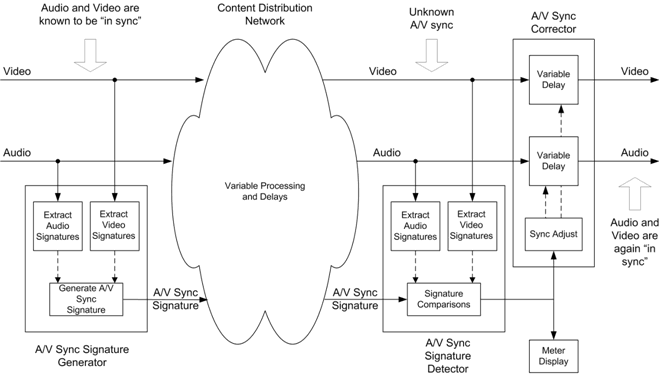
Real-Time
A/V Signature System Block Diagram
(with acknowledgements to Dolby Laboratories)
Although there
are some differences, it is believed that all these fingerprint-based
systems have similar capabilities and the signature or fingerprint
comparison will work even when the program material has been passed
through multiple links in the chain, including addition of bugs
and overlays, distribution as compressed bitstreams and other
video and audio processing. The method by which the signature
or fingerprint is carried from one point to another is not critical,
and can be implemented as metadata embedded in the video signal
(e.g., in baseband VANC) or through a separate network connection
or via the Internet. The other common feature is that they all
measure the change in A-V sync from the input reference point,
and do not measure the absolute sync accuracy of video and audio.
Coordination with upstream program sources is therefore still
required to ensure a high degree of confidence that incoming signals
have minimum A-V sync errors.
The
Need for a Standard
As they have been developed independently, the algorithms used
to produce the A-V sync signature or fingerprint, and the exact
form of the metadata are almost certainly different in the three
systems mentioned above and will require the equipment at different
points in a broadcast chain to be from the same manufacturer.
In the world
of broadcasting, however, the entire chain from production to
station output is not usually under the control of the broadcaster
and it is highly desirable that equipment from different manufacturers
should interoperate when used at different points in the chain.
Ideally, the form of the fingerprint signal, and its method of
carriage should be standardized, such that the fingerprint generated
by equipment from one manufacturer, say at a production studio,
post house or network release center, will be able to be read
by equipment from another manufacturer downstream, say at a broadcast
station, and used as input to the delay measurement that can be
used to correct any lip sync error detected, before transmission.
The same techniques can be used by broadcasters to detect A-V
errors introduced in their signals by downstream systems such
as cable or satellite.
The SMPTE
22TV Lip Sync Ad Hoc Group, chaired by Graham Jones of NAB, has
just started to investigate the possibility of producing a SMPTE
standard for the fingerprint signal and/or the method(s) of metadata
carriage. Potentially, this could require the manufacturers of
existing products for these systems to cooperate to harmonize
the fingerprint signals used in their products so they can interoperate.
This is much more likely to happen if broadcasters, who are perhaps
the main customers for such systems, make known their desire for
a single standardized fingerprint system. For those with long
memories, this situation has happened before, when pressure from
customers resulted in Ampex and Sony modifying their similar,
but slightly different, 1-inch VTR products to comform with what
became the SMPTE Type C Standard, which for many years was the
most widely used professional videotape format.
Readers of
TV TechCheck who would like to support an initiative for
a single A-V Sync Fingerprint standard are encouraged to contact
Graham Jones at gjones@nab.org
with their comments.
2010
NAB Show Call for Speakers
Call
for Technical Papers – NAB Broadcast Engineering Conference
 The
2010 NAB Show will host the 64th Broadcast Engineering Conference.
This world-class conference addresses the most recent developments
in broadcast technology and focuses on the opportunities and challenges
that face broadcast engineering professionals. Each year hundreds
of broadcast professionals from around the world attend the conference.
They include practicing broadcast engineers and technicians, engineering
consultants, contract engineers, broadcast equipment manufacturers,
distributors, R&D engineers plus anyone specifically interested
in the latest broadcast technologies. The
2010 NAB Show will host the 64th Broadcast Engineering Conference.
This world-class conference addresses the most recent developments
in broadcast technology and focuses on the opportunities and challenges
that face broadcast engineering professionals. Each year hundreds
of broadcast professionals from around the world attend the conference.
They include practicing broadcast engineers and technicians, engineering
consultants, contract engineers, broadcast equipment manufacturers,
distributors, R&D engineers plus anyone specifically interested
in the latest broadcast technologies.
Do you have something to share?
If you feel qualified to speak at the NAB Broadcast Engineering
Conference, we invite you to submit
a technical paper proposal. Not all acceptable submissions can
be included in the conference, due to the large number of submissions
that are received and the limited number of available time slots.
PLAN TO ATTEND!
The IEEE Broadcast Technology Society
59th ANNUAL BROADCAST SYMPOSIUM
October 14-16, 2009
The Westin Alexandria
Alexandria, VA, USA
www.ieee.org/bts/symposium
2009 ATSC Seminar on Audio Loudness
Wednesday, November 4, 2009
Wiley Rein Conference Center
1776 K St, NW
Washington, DC 20006
http://www.atsc.org/seminars/loudness09.php
Cost for ATSC members is $50.00 for pre-registrants, $75.00 on-site.

The
October 5, 2009 TV TechCheck is also available
in an Adobe Acrobat file.
Please
click here to read the Adobe Acrobat version of TV
TechCheck.
|
